

What Is Vegetable Tanned Leather and is it Superior in Quality?


Vegetable tanned leather is leather preserved using natural tannins extracted from tree bark, leaves, and roots. Most commonly oak, chestnut, mimosa, and quebracho instead of chromium salts. The process takes between 30 and 60 days (compared with 1–2 days for chrome-tanning), produces leather that develops a rich patina over years of use, and represents less than 10% of global leather production. It is the leather of choice for us Galen Leather.
This guide is about understanding what you're buying, how to spot the real thing, and how to choose the right piece for your needs.
What is Vegetable Tanned Leather?
Vegetable-tanned leather is made using natural tannins found in organic materials to add a unique look and feel to the animal hide. Harmful chemicals are avoided.
We love using this kind of leather in our range, including for our popular leather journals and leather gifts.
While the names may sound similar, vegetable-tanned leather is not to be confused with vegan leather, which is not a real leather product at all.
To better understand how vegetable-tanned leather differs from other types of leather products, it’s important to know how it’s created. So we're going to dig deep into the leather tanning process.
How is Vegetable-Tanned Leather Made?
Vegetable-tanned leather is made by submerging animal hide in a water or saltwater solution. This removes the fur and makes the hide flexible. Vegetable-based oils and waxes are then applied for a tender, malleable finish.
The Leather Tanning Process
Vegetable-tanned leather begins immediately after an animal is slaughtered. The "green" or new hide is salted to preserve it then hung in a structure called a beam-house.
From there, the hide is moved to a liming pit where it is immersed in a natural chemical substance called lime to remove the hair from the hides through dissolution.
Hides are then placed in a vat containing tannin — in this case, natural tree bark or other organic materials. This soaking process helps to dehydrate the leather, contributing to softness and a nice hand feel.
The vegetable tanning process is a long and artisanal one, taking up to two months to complete, which is why leather is more commonly tanned with minerals like chromium.
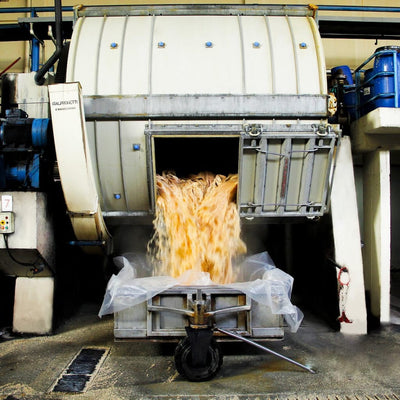 Unloading Drums
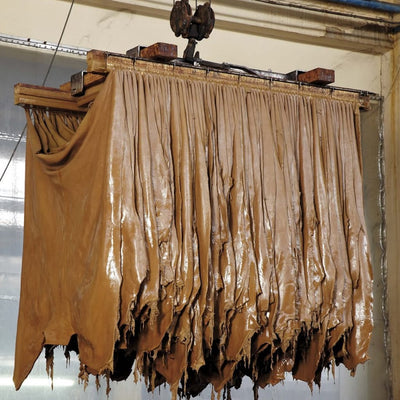 Traditional Tanning
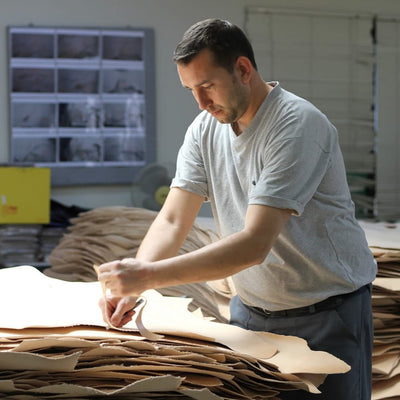 Leather Trimming
Why Vegetable-Tanned Leather is Preferred
While chromium or chrome-tanned leather is cheaper to produce, and the colors stay constant for longer, vegetable-tanned leather has the longevity and beauty only an artisanally-crafted product can sustain.

Source : Buckle Guy
Chrome-tanned leather often has its edges treated with acrylic varnish, causing it to crack, peel, and split after just a few years. In addition, the mineral chromium is a heavy metal and as such is quite toxic to the environment as well as to the people processing it.
The long, slow traditional techniques used to process the hides for vegetable-tanned leather means that vegetable-tanned leather goods continue to soften and develop a beautiful patina as they age.
For items made from vegetable tanned leather include saddles, holsters, belts, wallets, journal covers, bags, shoes, and purses, this means they will become even more comfortable the longer you use them. The edges of vegetable-tanned leathers are burnished or turned, meaning this leather is created to last for decades. Usually, this kind of leather is stiff in the beginning but gets more supple with time and use.
Also, vegetable-tanned leather has that distinctive “leather” aroma, rather than the typical chemical odor of chromium-tanned goods. The fragrance is sweet, woody, and rich.
Also, the natural leather tanning process leaves the leather with unique variations in shade and color.
The original fibers of the animal’s hide can easily be seen, adding to its character. A piece of vegetable-tanned leather is truly a one-of-a-kind product.
Finally, owing to its artisanal nature, the vegetable tanning process produces some of the sturdiest, most durable leathers available. It’s a much less pliable product than chromium-tanned leather, so it’s used where stiffness can be an asset, such as saddlery, holsters, wallets, notebook covers, travelers notebooks, and handbags. Due to the artisanal nature of the tanning process, Vegetable-tanned leather is more expensive than chrome leather. It’s usually used for high-end handmade leather goods.
However, it does get wonderfully soft and pliant over time, so many manufacturers create shoes, bags, belts, and other long-lived products using this material.
While this method of tanning does use quite a bit of water, it does not pollute the environment the way the chromium-based leather tanning process does. There is also less machinery, and so less electricity, involved with the vegetable tanning process.
Vegetable Tanned vs Chrome Tanned Leather Comparison
Chrome Tanning |
Vegetable Tanning |
|
% of leathers |
92% |
8% |
Smell |
Typically have a chemical smell |
Aromatic woody smell |
Softness |
Softer than vegetable tanned leather |
Can be a bit stiff when first tanned, but softness will increase with time |
Ingredients |
Chemicals, Acids |
Natural like tree bark |
Environmental |
Bad |
Environmentally Friendly |
Time |
1–2 Days |
40–60 Days |
Water use (per m²) |
~140–200 L |
~50–60 L |
CO₂ (per kg) |
~15–20 kg CO₂e |
~8–12 kg CO₂e |
Production |
Mass Produced |
Requires skilled craftsman |
Price |
Cheap |
Expensive |
Aging |
The look of the leather is not very natural |
Will have a rich patina that gets better with use |
Vegetable Tanning Process
Source: Sepiciler
Undyed Vegetable Tanned Leather Aging

Source : il Bisonte
When you get your brand new undyed vegetable-tanned leather good, it looks a natural color. The hide is effectively naked and so will age and darken with the sun just like your own skin. Aging will continue to darken your leather. Normal wear will darken the leather as air, light, the oils of your skin, and other environmental factors do their work, eventually developing a rich color and patina. Sun exposure, daily handling, water, and conditioning give natural vegetable tanned leather a rustic look over time. Learn how to condition leather here.

Source : Paper Republic
The aging process of leather takes time. After a while, you’ll be rewarded with a gorgeous patina that makes your product one-of-a-kind. Patina development depends on what type of product you have and how you use it – a small, natural vegetable tanned leather wallet may age much more quickly than a large leather bag that isn’t used and handled as much. You can speed up the aging process if you’re impatient to see results. Using a natural leather balm or more exposure to the sun will darken your leather.
What Patina Actually Looks Like — A Timeline
New buyers often don't know what to expect. Here are broad expectations for a mid-toned natural veg-tan product (a wallet or journal cover), carried daily:
- Week 1–2 — stiff, lightly glossy, uniform tone. May show a fingerprint or two.
- Month 1 — first darkening in high-contact areas: the edges of a wallet, the spine of a journal cover.
- Month 3 — recognizable patina is forming. Contact areas a shade or two darker than unused areas.
- Month 6 — distinctly darker on surfaces you touch daily; the color starts to deepen toward a rich tan or honey.
- Year 1 — substantial, noticeable patina. The object feels (and looks) like it's yours.
- Year 3–5 — fully characterful. No longer resembles the new version.
- Year 10+ — heirloom territory if cared for.
A natural (undyed) veg-tan product will patina most dramatically. Deeply dyed veg-tan products patina more subtly — the base color masks some of the shift.
How to Tell if It's Really Vegetable Tanned
A growing issue in the market: products sold as "veg-tan" that are actually chrome-tanned with a wax finish to mimic patina behavior. Four quick checks before you buy or shortly after:
- Smell. Genuine veg-tan has a distinctive earthy, slightly sweet aroma. Chrome-tanned leather smells chemical, or of nothing at all.
- Cut edge. Look at an unfinished edge. Veg-tan is usually a warm cream or tan color all the way through. Chrome-tanned leather shows a blue-grey tone in the cross-section — that's the chromium-sulphate color.
- Water response. A small drop of water on veg-tan darkens immediately and lightens as it dries. On chrome-tanned leather, water often beads and runs off.
- Stiffness on arrival. Genuine veg-tan is firm and needs breaking in. If a "veg-tan" product is soft and floppy out of the box, be suspicious.
Also watch the wording on labels. "Vegetable tanned with mineral finish" is chrome-tanned. "Partially vegetable tanned" usually means mostly chrome. The claim you want is "100% vegetable tanned" with a named tannery or certification.
Caring for Your Vegetable-Tanned Leather

Old Swiss Army Bag - Before and after Galen Leather Balm
Because vegetable-tanned leather is more expensive than chrome-tanned leather, you’ll want to take good care of it to get the most extended life from your leather product.
Here are a few tips to keep your artisanal leather looking its best:
- Don’t get it wet, particularly in the first month
- Keep your leather away from heat sources and never blow-dry it
- Don’t use brushes with synthetic bristles to clean it — only natural bristles should be used
- Use oil or conditioner made specifically for leather weekly if the item is used frequently
- Wax occasionally to keep it in the best condition
With proper care, you can expect to get years of use from your vegetable-tanned leather goods.
Vegetable-Tanned Leather Tanneries
Below you can find a list of the well know vegetable-tanned leather tanneries in the World.

Hermann Oak - MO United States - hermannoakleather.com
Horween - IL United States - horween.com
Lucy Saffiano - United States
Marbella - Spain
Rawlings Tennessee Tanning Co. TN United States tntanningcompany.com
S.B. Foot Tanning Co. - MN United States - sbfoot.com
Sepici Leather- Izmir Turkey - sepici.com.tr
Tasman - ME United States - tasmanusa.com
OA Leather Supply - CA - Online Leather Supplier
Wickett & Craig - PA United States - wickett-craig.com
Loving— and Living With — Vegetable-Tanned Leather

If you want a gorgeous leather product you know will provide years of beauty and usefulness, you should consider purchasing a product that’s been lovingly created from fine, high-quality vegetable-tanned leather.
This leather is kind to the environment, doesn’t expose its creators to toxic substances, and requires a level of craftsmanship that is rarely seen in today’s world of fast-paced manufacturing by machine.
Vegetable-tanned leather represents the epitome of quality and beauty and is created to provide a lifetime of use. Discerning buyers understand the artistry and creativity that goes into creating leather of this quality.
Best of all, products created with vegetable-tanned leather are often classics in and of themselves and make beautiful heirlooms to be passed — and treasured — from generation to generation.
Vegetable Tanned Leather FAQs
- +Is vegetable tanned leather better than chrome tanned?
- For items you'll use daily over years — wallets, belts, journals, bags — vegetable tanning produces a material that ages better and carries a lower environmental cost. For applications requiring softness, water resistance, or low price, chrome tanning is often the better fit.
- +How long does vegetable tanned leather last?
- A well-cared-for full-grain vegetable-tanned product lasts 20+ years of regular use, often becoming more attractive with age rather than wearing out.
- +Why is vegetable tanned leather more expensive?
- It takes 30 to 60 times longer to produce than chrome-tanned leather, requires skilled craftspeople, and uses more costly natural tannins. The premium reflects real additional cost, not only positioning.
- +Is vegetable tanned leather waterproof?
- No. Vegetable tanned leather absorbs water and can darken or stain. Water resistance improves with conditioning and wax treatment, but it will never be fully waterproof.
- +Does vegetable tanned leather smell?
- Yes — distinctively. Genuine vegetable-tanned leather has an earthy, slightly sweet aroma that comes from the natural tannins. Chrome-tanned leather smells chemical or not at all. The veg-tan smell is a reliable authenticity signal.
- +Can I be allergic to vegetable tanned leather?
- It is very rare. People with chromium contact sensitivities (which affect 1–3% of adults) can usually wear vegetable-tanned leather with no reaction.
- +What is the best vegetable tanned leather in the world?
- Tuscan vegetable tanned leather, certified by the Consorzio Vera Pelle Italiana Conciata al Vegetale, is widely considered the global benchmark. Leading US tanneries (Wickett & Craig, Hermann Oak) and UK tanneries (Sedgwick, J & FJ Baker) produce comparable quality for specific applications.
- +How to identify vegetable tanned leather?
- Here are some simple tips for identifying the tanning method used for a sample of leather. Wet a piece and then stamp a mark into it. If the mark has a crisp impression afterward, the leather is vegetable tanned. If the impression is just discernable, it is chrome tanned. An easy way to test whether leather is 100% vegetable tanned is to drop a small strip of the leather into boiling water (be careful). If it is 100% vegetable tanned it will instantly shrink and curl up like a worm. If it doesn't, other tanning agents have been used. Chrome tanned, undyed leather is a pearl grey with a faintly bluish tint. Dyed chrome tanned leather often retains a grey-blue or white center core. Beware of chrome tanned leather for knife sheaths — it can corrode the metals.
- +How to shape vegetable tanned leather?
- Since leather is a naturally pliable substance, it is possible to shape and mold it into a very wide variety of forms. Leather molding projects can be quite simple or extremely advanced, but in all cases use the same very basic process. The first step is soaking the leather in hot water to make it easier to shape and more capable of holding its shape. After you remove the leather from the water, immediately start molding it into the basic shape you want. Once the leather is in the correct shape, let it sit overnight to fully dry and harden.
- +Is vegetable tanned leather vegan?
- No. Vegan leather is a petroleum-based textile popularly known as polyurethane or PVC.
- +Is vegetable tanned leather full grain?
- Vegetable tanned leather is available in full grain and top grain grades. You can read our past blog post about leather grades.
- +How does vegetable tanned leather age?
- Sun exposure, daily handling, water, and conditioning give natural vegetable tanned leather a rustic look over time. See the patina timeline above for month-by-month expectations.
- +Can vegetable tanned leather get wet?
- If leather gets wet, dry it with a paper towel or cloth, then let it air dry. After getting wet, leather may start to grow fungus if in a high humidity environment.
- +Can you dye / color vegetable tanned leather?
- Sure. With special leather dyes produced for this kind of leather, you can dye it to any color.
- +What is vegetable tanned leather made of?
- Mostly from cowhides.
- +What is semi vegetable tanned leather?
- It is a kind of leather tanning with mixed chrome and vegetable tanning methods.
- +How to seal vegetable tanned leather?
- Seal with brass and metal molds. Both hot and cold embossing. This is the traditional way for the best results. Hot embossing burns and changes the color of the leather.
- +How to waterproof vegetable tanned leather?
- For waterproofing leather, we would suggest something like Galen Leather Balm. As it says on the can, it waterproofs, restores, and protects. For better waterproofing, apply twice. One thing to note is that you'll never make a bag 100% waterproof, but you can make it resistant to most conditions.
- +How to soften / smooth vegetable tanned leather?
- The best solution for softening is to apply natural olive and neatsfoot oil — though for daily-use items, our Leather Balm is the safer choice as olive oil can go rancid over years.
- +How to darken vegetable tanned leather?
- Just apply a kind of natural oil, like olive oil or neatsfoot oil. Also, sun exposure, water, and conditioning darken the leather over time.
- +How to treat / condition / protect / polish vegetable tanned leather?
- For conditioning the leather, you can use natural oils and beeswax. We'd also suggest something like Galen Leather Balm. As it says on the can, it waterproofs, restores, and protects.
- +How to stiffen vegetable tanned leather?
- Water. Soak leather in hot water and submerge with the assistance of some heavy items on the leather overnight. When dried completely, the leather will be more stiff.

4 Responses

Denise
Hi there
Do you have a colour chart of your different colour options available?
Also, would you consider doing a C.H. Distressed pale pink colour. Boy I would love that.
Thanks
Denise x

lustigear
To say the fact I am very stunned at what you informed. You discuss plenty of exciting details, nice and outstanding style you have got here. It’s certainly one of the most useful things on this subject I’ve ever study.

Maes & Hills
Is vegetable tanned leather the same like vegan type leather? I have found this brand ‘Socha’ on this website https://maeshillscollection.com/de/ and was wondering about the differences or similarities.
Kind regards,
Anne

Tricia
Do you have any products that would darken the lighter spots on these? They are new Bed Stu vegetable tanned distressed boots. I don’t like the super light spots on the ankle and crease of the foot. Is there anything I can put on it to try and blend it with the rest of the boot. Don’t care if the whole boot gets darker. Won’t let me add a picture
Leave a comment
Comments will be approved before showing up.
Also in Blog


Best Notebooks for Fountain Pens (Reviewed by us)


24 Leather Gift Ideas for Your Third Wedding Anniversary
The third anniversary is typically a measure of a marriage's beauty, flexibility, and resilience. This automatically makes leather the perfect third-anniversary gift for your spouse.


Galen Leather
Author